Token Efficiency
A gas gauge and a map for coding agents
Two tools for seeing what your agents spend and read. Use them, or have your agent build your own.
The gas gauge. A status line for Claude Code: what this session would cost at API prices, how much of your week is gone, how full the context is, and which model is answering. It turns yellow when you are spending faster than the week is going by. No dependencies. Get it on GitHub.

Sample values.
uv tool install git+https://github.com/ivantohelpyou/claude-gas-gauge
ctx, the map. Every dot is a note your agents can read, and a search that hands them only what they need. On real questions from seven repos, the median was nine times fewer tokens than a simple search-and-read agent, one that lists the matching files and reads the top three whole. On my largest set of notes, the question below came in about 72 times lower. Get it on GitHub.
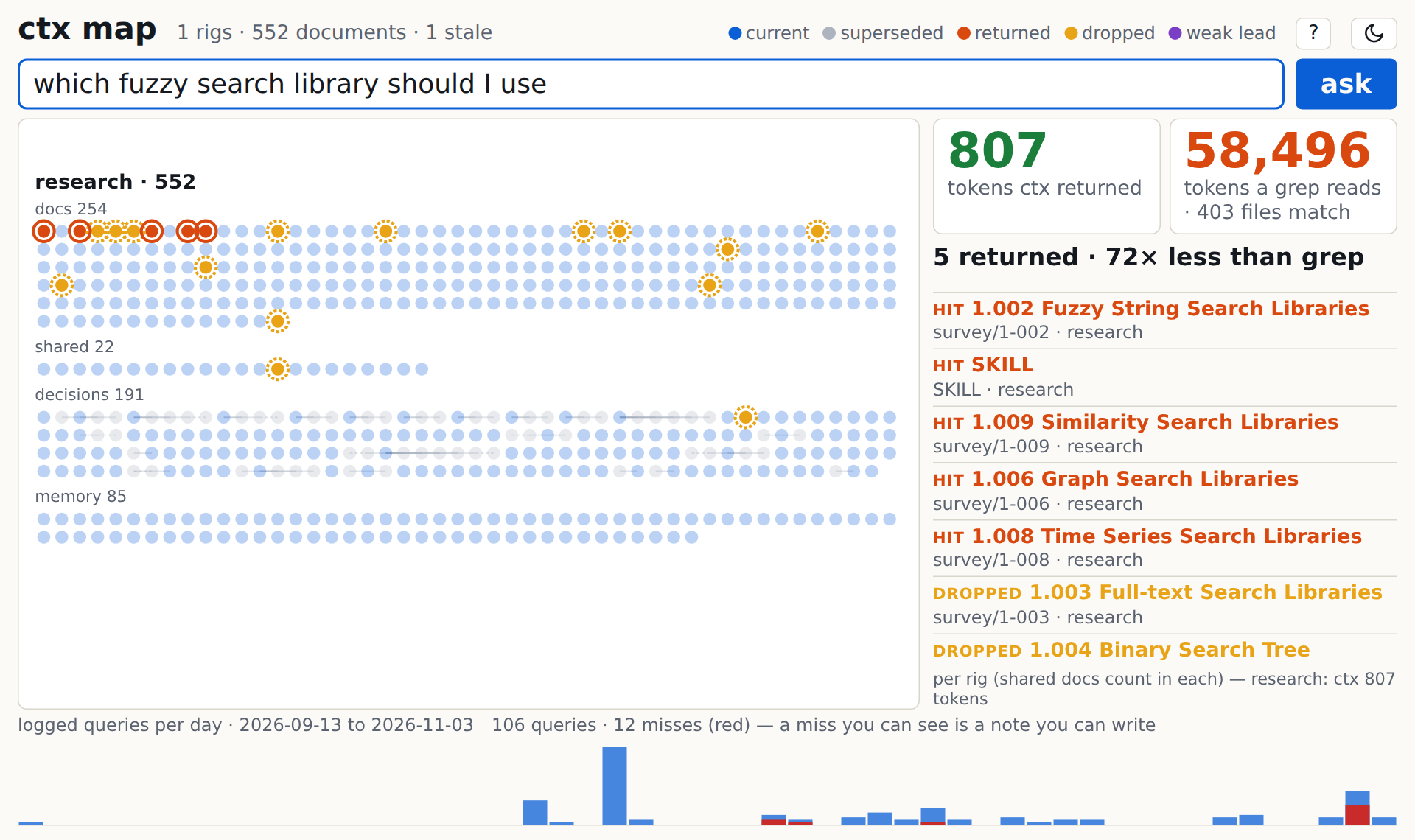
uv tool install git+https://github.com/ivantohelpyou/ctx
The method. The gauge and ctx are free. The cost accounting I showed on stage is not released: I teach it. Every session is a cost object, every repo a cost center, and last week's spend is this week's budget. If you want that for yourself or your team, ask me about the workshop.
What it built. Everything below is public, and one person built it with coding agents.
The accounts. Fifteen years of the Seattle Convention Center's audited statements, where anyone can check a figure against the page it came from.
The buildings. The same center's two main buildings as a database: 373 spaces, read from its own documents.
Survey of Software. The research library behind the map above, which Claude can consult directly as a skill.
The Convention City Dispatch. A local news site on a CMS I built myself, reported from public records. How it's made lays out the research method: the machine finds and drafts, and I read every word against the records.
aiggs. A language trainer for your phone: listen to a conversation without the words, read it, then get the grammar. The starter lessons need no account.
purr. Games for a room of phones. No app, no account: one person starts, and everyone else joins with a code.
Samples. Made-up examples of the small-organization apps my database tool builds: a condo building's dues and reserves, a book club, a membership association.
Bringing this to your event?
Tell me the date and who is in the room, and I will tell you whether it fits. I adapt it to the audience.
Useful in a first email: the date, the city, roughly how many people, and what they do all day.
What happens in the room
- The ideaThe discipline of token efficiency turns a small budget into big results.
- The live momentA real question to the map, with the tokens ctx returned beside what a simple search-and-read agent would use.
Field notes
Monthly notes on AI-assisted development — what I'm shipping, what I'm learning, and which tools actually earn their place. It's also where the next talk and the next office hours get announced.
Talks · Reports · Survey of Software · ivantohelpyou.com
Model Citizen Developer · Ivan Schneider · [email protected]