Ignition Successful
November 20, 2024
Comparing keynotes. Plus, takeaways from Day 1 of Microsoft Ignite (virtual)
Early last December, after watching Satya Nadella's 2023 keynote on YouTube, I started my Power Platform journey.
What struck me about that keynote was its conceptual completeness, the AI story embedded at every level starting from AI infrastructure at the data center and then moving up the stack from development tools to business applications, with Copilot Studio (part of the Power Platform) sitting at the top.
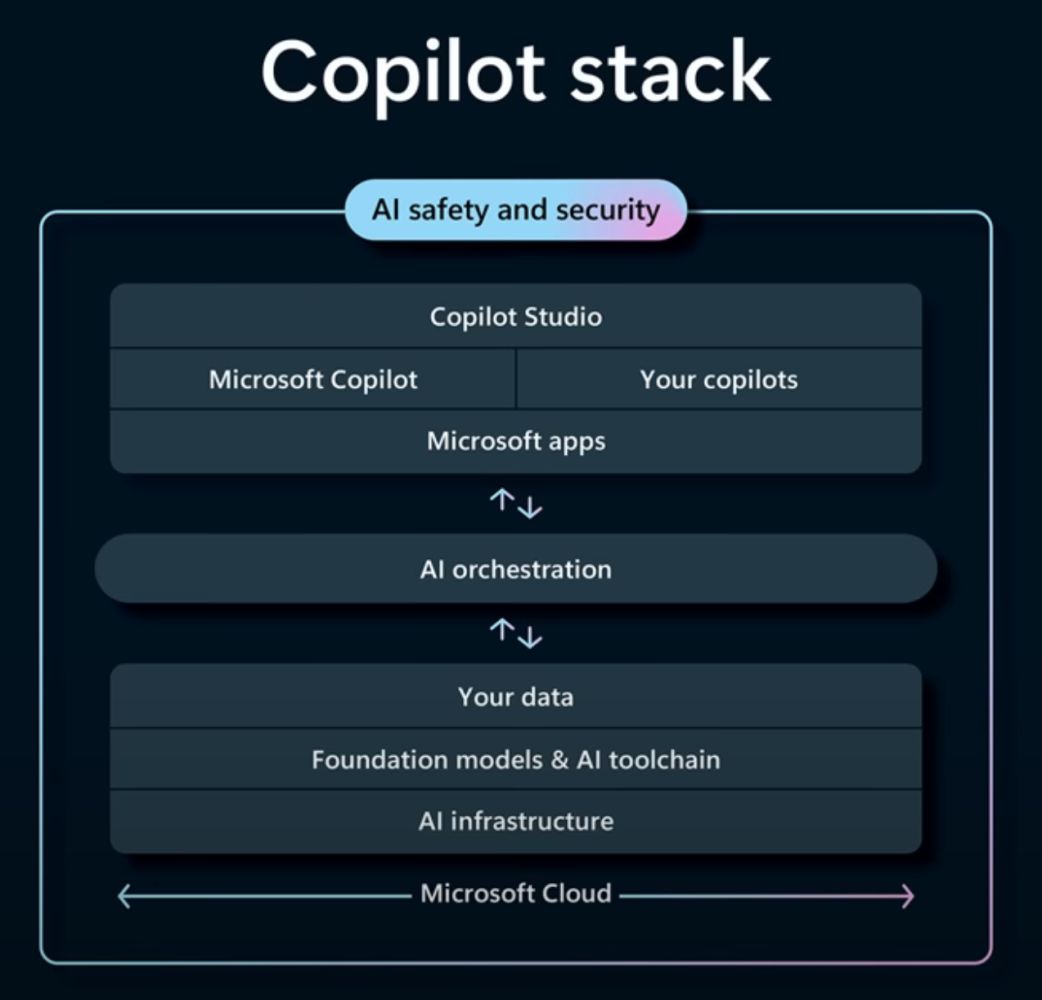
Graphic from 2023 Ignite Keynote
It was a compelling vision, and I resolved to take part.
Over the last year, I've refreshed my knowledge of relational databases and Python programming; achieved the Power Platform Functional Consultant (PL-200) certification; and won the "Got Power" award for storytelling at the annual Power Platform Community Conference.
Plus, I built a solution for generating QR Cards using Power Automate, Power Apps, Power Pages, and Azure.
In doing so, I learned how to work with Github Copilot, how to deploy Python code to Azure Function Apps, how to create Azure Resource Manager templates using Bicep and the Azure Developer CLI, and how to deploy from dev to test and prod. A good start.
This year's Ignite keynote started at the top and moved its way down through a compressed version of the stack.
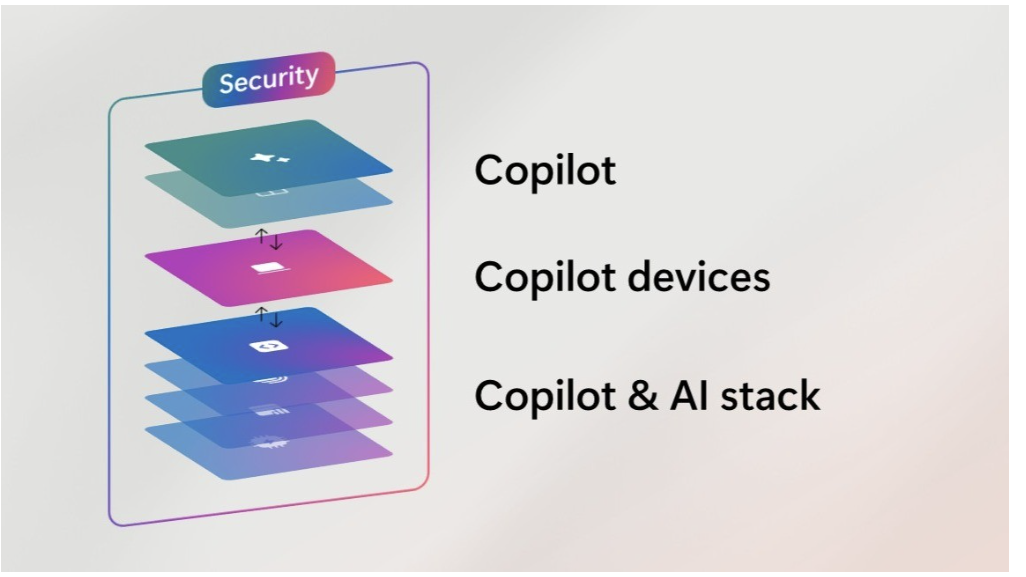
Graphic from 2024 Ignite Keynote
- Copilot: "The UI for AI," with a multimodal universal interface; Copilot Studio for creating agents; and Copilot integrated into Microsoft 365.
<!-- -->
- Copilot devices: Copilot+ PCs and the new Windows 365 Link, a Cloud PC that streams a virtual PC to any device.
<!-- -->
- Copilot & AI stack. Everything else.
I can take a hint. It's time to focus on Copilot.
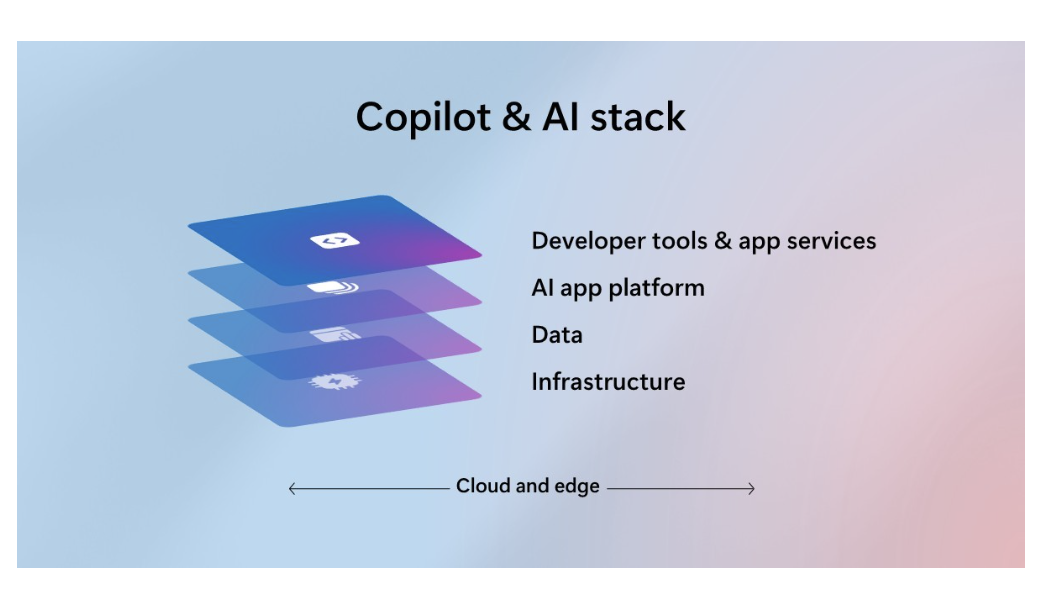
Drill-down on Copilot & AI stack
Here are my takeaways from Microsoft Ignite, Day 1.
-
Copilot Studio will have a pay-as-you-go option. Previously, the only option was $200 per month for 25,000 messages, which was a high bar for experiments and proof-of-concept applications on behalf of small clients. That's why I didn't bother spending much time building Copilots. But now, at a rate that I expect to land at around a penny per message, I can imagine a wider range of possibilities. And it's much easier to sell that way.
-
Copilot Studio will have third-party models, advanced tuning, and retrieval-augmented generation. That means it's no longer tied at the hip to OpenAI. Not that I had any issue with OpenAI, but the reality is that I haven't yet experimented with the entire range of models out there. And now I can do so easily.
-
Azure AI Foundry is to Copilot Studio what Logic Apps is to Power Automate -- a pro dev tool that allows you to build projects that draw from any number of models and services. Microsoft calls AI Foundry "the app server for the AI age." Seems worth learning.
-
Here's an AI model that's high on my list: tsuzumi from NTT DATA. It's been trained with context from Japanese sources, and it's ultra-lightweight to conserve energy. お話できるのを楽しみにしています。
-
Back to Copilot Studio, we'll be able to create libraries of autonomous agents that react to events, triggers, or scheduled timings. Think of it as an AI wrapper for Power Automate. Instead of calling an instant flow by preparing a payload and pressing a button, you can let the autonomous agent generate the payload and then press the button on your behalf. (And to make things even more exciting, Power Automate now includes Generative Actions that you can call from within a flow.)
-
Agent builder in Power Apps will examine your existing apps and automatically build autonomous agents that will probably do about two-thirds of what you need them to do.
-
Plan designer, announced at PPCC24, generates a document you'd expect from a business analyst. After an iterative discussion with Copilot, you'll get back entity-relationship diagrams (ERDs), user roles, and business requirements for the system you're trying to build. From there, Copilot will start you off with the requisite database tables, apps, and automations, and you can take it from there.
That should keep me busy until Ignite 2025.