
Spike IKE
September 5, 2024
Last Thursday, the Seattle Design Commission voted 4-3 against the proposal to award a 30-year permit to install IKE ("interactive kiosk experience") digital advertising and information kiosks throughout Downtown Seattle, Belltown, and Denny Triangle in the first phase; and then in Ballard, the U Distrct, SoDo, and West Seattle Junction in a second phase.
But it may happen anyway. According to The Urbanist, the project is backed by the Downtown Seattle Association and strongly supported by the Office of the Mayor "as providing a big benefit for downtown visitors and as a major aspect of the city's preparation for the 2026 FIFA Men's World Cup" (article).
I realize that it's a quick way to bolster a challenged budget. But if we're talking about a 30-year commitment, I believe we need a little more of that famous Seattle Process by inviting more community input for an inclusive approach to decision-making.
In that spirit, I respectfully submit my opposition to the proposal, along a list of 10 questions that reflect my concerns.
This is why I care
Since early 2021, I have lived in Convention City, the neighborhood at the intersection of Downtown Seattle, First Hill, Capitol Hill, and Denny Triangle.
I don't own a car, and I rarely bike in the city.
I have an ORCA card for travel by bus, light rail, streetcar, and ferry.
Mostly, I walk.
As such, mine is first and foremost the perspective of a resident who travels mostly on the sidewalks. This is something I would have to live with on a daily basis.
Secondly, I'm a homeowner. We bought an apartment in the city with the expectation that the experience of living downtown would steadily improve from the low point of the pandemic. If permanent fixtures are to be installed, I want them built with residents foremost in mind.
Thirdly, I'm very attuned to the question of how best to deliver information to visitors, as I'm in the process of building a smart solution for guest recommendations that I believe to be innovative, effective, and fun -- plus, much more unobtrusive, and with direct benefits to businesses.
Minimize image
Edit image
Delete image
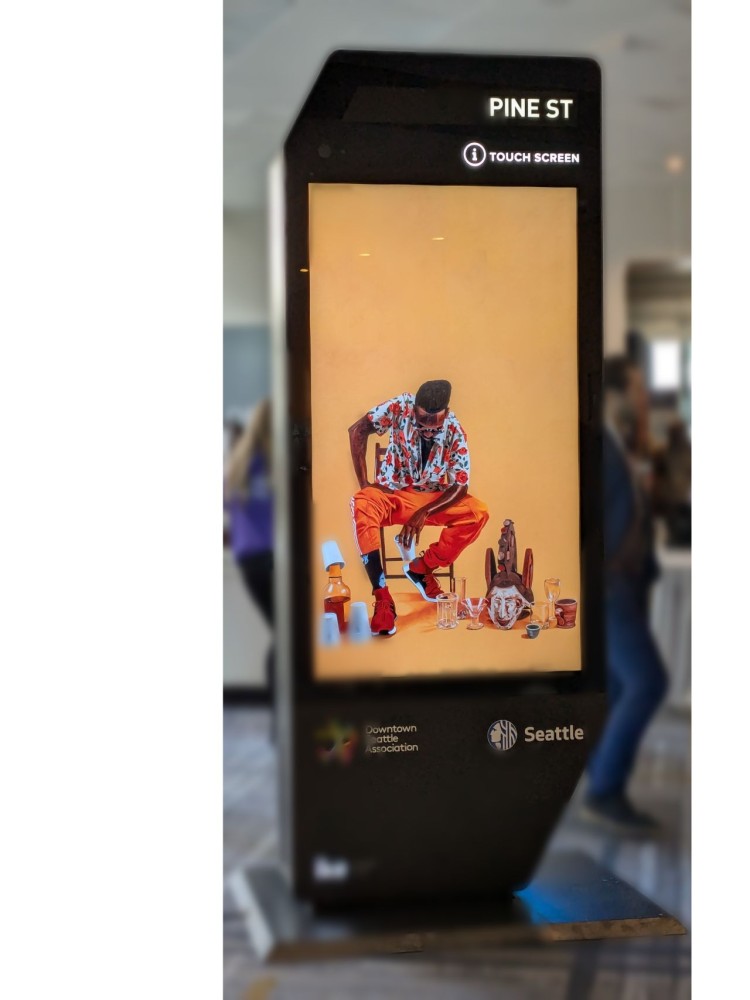
IKE, as seen at the International Downtown Association Annual Conference 2024 Seattle (#IDASEA24)
10 Questions About Kiosks
-
How would kiosks affect retailers in Downtown Seattle? If you operate street-level retail in Downtown Seattle, your window display is your biggest advertisement. If you're sharing the sidewalk with a kiosk, will pedestrians turn their attention away from storefronts toward screens? How will merchants compete with eye-catching designs from the world's top marketers?
-
Would advertising messages conflict with retailer displays? Will the kiosks show ads by competitors? DoorDash vs. restaurants? Coca-Cola Santa vs. Nordstrom Santa? Mass-market brands vs. local businesses?
-
How would kiosks affect the market for large floorplate retail vacancies? Suppose you put a kiosk in front of a now-vacant storefront. Will the presence of a 24/7 billboard through 2055 make that property more attractive, or less attractive, to a potential tenant? How will a kiosk affect curb appeal?
-
How would retailers compete for attention? Will they respond by installing more blinking, glowing, and flashing signs of their own?
-
How would a kiosk's recommendations compare to those from the Destination Marketing Organization? Visit Seattle maintains a curated collection of guides, activities, restaurants, bars, and hotels. Will those curated options be given priority on a kiosk, or will it be a basic map search, sorted only by distance, as demonstrated at #IDASEA24? And if the new kiosks do provide different experiences, what does that mean for the kiosks at the Convention Center, or for the Visit Seattle Information Desks?
-
How would the information on a kiosk compare to information available on one's own mobile phone? Will there be any options for personalization, favorites or suggested itineraries based?
-
What are the privacy and safety considerations? Does it make sense to show everyone on the street where you're headed next? Or that you're not from around here? Or that you don't speak English as your first language? In an ideal world, sure.
-
Will kiosks impede movement on the sidewalk? Pedestrians already navigate an obstacle course of scooters and e-bikes strewn about on the sidewalk, along with the high-speed riders who use scooters and e-bikes on the sidewalk. Will this pose an additional risk to pedestrians, particularly at the points where the sidewalk narrows?
-
Will kiosks still deliver value to visitors in 2030? 2040? 2055? We're at the cusp of incredible technological transformation with artificial intelligence. Does this solution sit at the forefront of this change? If so, how is that manifested in terms of benefits to visitors and residents?
-
How does this help Seattle's reputation as a technology leader? Do we have any local companies based in the region whose world-leading technologies may be highlighted to a global audience while delivering public benefits and revenue generation for the city and the region?
And now for a brief word from Convention City Seattle
Here's a small part of the solution for improving the visitor experience: printed or digital QR Cards with guided itineraries.
I'm envisioning these cards being distributed at retail, as well as at information booths, concierge desks, and public facilities.
Each printed card has a unique QR Code that links to a customizable webpage.
Just scan any card, and you'll receive concierge-quality recommendations, including destination information, turn-by-turn directions, and special offers.
If you're interested in sports, ask for a Sports card.
If you want Fine Dining, ask for a Fine Dining card.
QR Cards are:
-
Customizable. Use your artwork, your content, and your offers to complement your marketing.
-
Personalized. Quickly and easily add customized, private recommendations onto a card during the conversation, or even after the guest has left the building.
-
Reusable. Any card, or group of cards, can be reset and reprogrammed. That means you don't have to print new cards whenever the details change.
-
People-first. The best visitor experiences begin with conversations with another human.
Coming soon in 4Q24 from Convention City Seattle
The 2026 FIFA Men's World Cup is an opportunity to showcase our unique talents. We owe it to ourselves to ensure that we put our best foot forward on behalf of our businesses, our visitors, and residents alike.
As we approach a pivotal moment for Seattle's future, I urge you to join me in advocating for a more thoughtful approach to downtown development. Let's ensure that our voices are heard in the conversation about the IKE proposal.
Action steps:
-
Engage with Local Leaders: Reach out to your city council members and express your thoughts on the importance of community input in decisions that affect our neighborhoods.
-
Attend Community Meetings: Participate in discussions about the IKE project and share your perspective as a resident and business owner.
-
Spread the Word: Share this message with friends, family, and fellow residents. The more voices we have, the stronger our impact will be.
-
Support Innovative Solutions: If I may be so bold, we may consider exploring alternatives like my QR card initiative, which prioritizes personalized visitor experiences while supporting local businesses. By inventing better ways to support visitors, we can then turn our attention to a wider range of options for other civic needs, whether social services, security, or contextual advertising.
Together, let's ensure that our city stands ready to welcome our visitors face-to-face by showing them the very best that Seattle has to offer.
Ivan Schneider
Model Citizen Developer
Seattle, Washington