.png)
Clever Yarn
August 14, 2024
My friend (since 2nd grade) Jennifer Simonic is a co-founder of the Loose Ends Project, a nonprofit that matches volunteer handwork finishers with projects people have left undone due to death or disability.
If you want to cry, just visit their Instagram page. Go ahead, I'll wait.
Last weekend, Loose Ends was offered a complimentary vendor booth at Flock Fiber Festival, right here in Convention City at the Summit.
I was happy to help during the early shift on Saturday and the move-out on Sunday.
Plus, it was a pleasure to see my former supervisor and colleagues at Seattle Convention Center, where I worked during 2023 as an Admission Attendant.
In anthropomorphic terms, Admission Attendants are sheepdogs, herding the flock and keeping the wolves at bay.
I was a sheepdog for a year.
Then I became a lone wolf.
For the past eight months, I've been out on my own, learning how to program again.
My initial plan was to build a project portfolio that I could use to land a job as a functional consultant or solution architect.
And then my portfolio project turned into a full-fledged business plan.
After all, if I can generate cash through my own efforts, why work for someone else?
It's worth a shot.
I'll have something to show for it at next month's Power Platform Community Conference 2024 in Las Vegas.
And in the meantime, I'm excited about putting my citizen developer skills to work wherever they're needed.
At Flock, I asked Jen about the technology at Loose Ends.
Everything is still mostly done by hand.
For example, here's the Loose Ends QR Code.
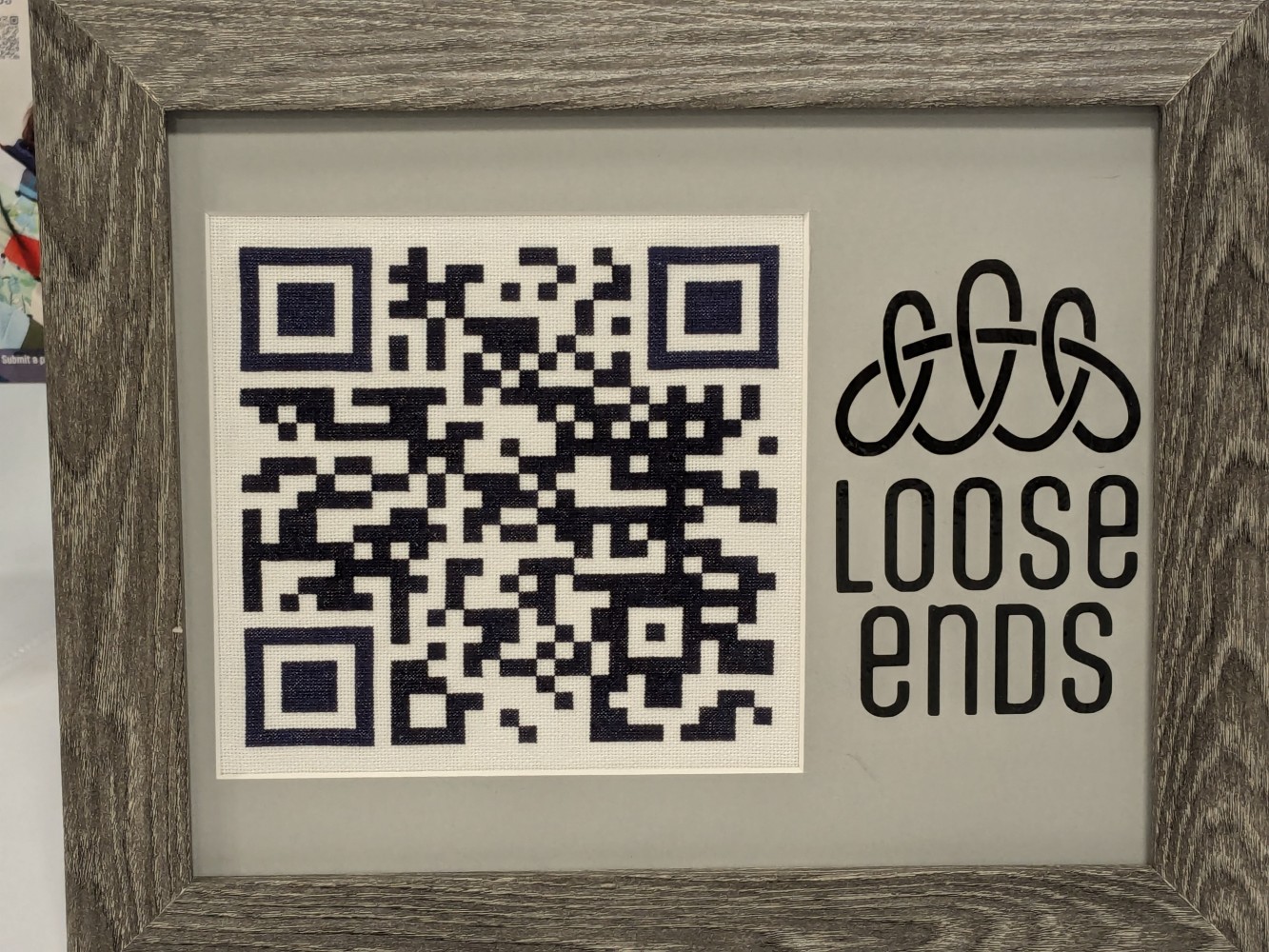
Loose Ends QR Code
Take a closer look.
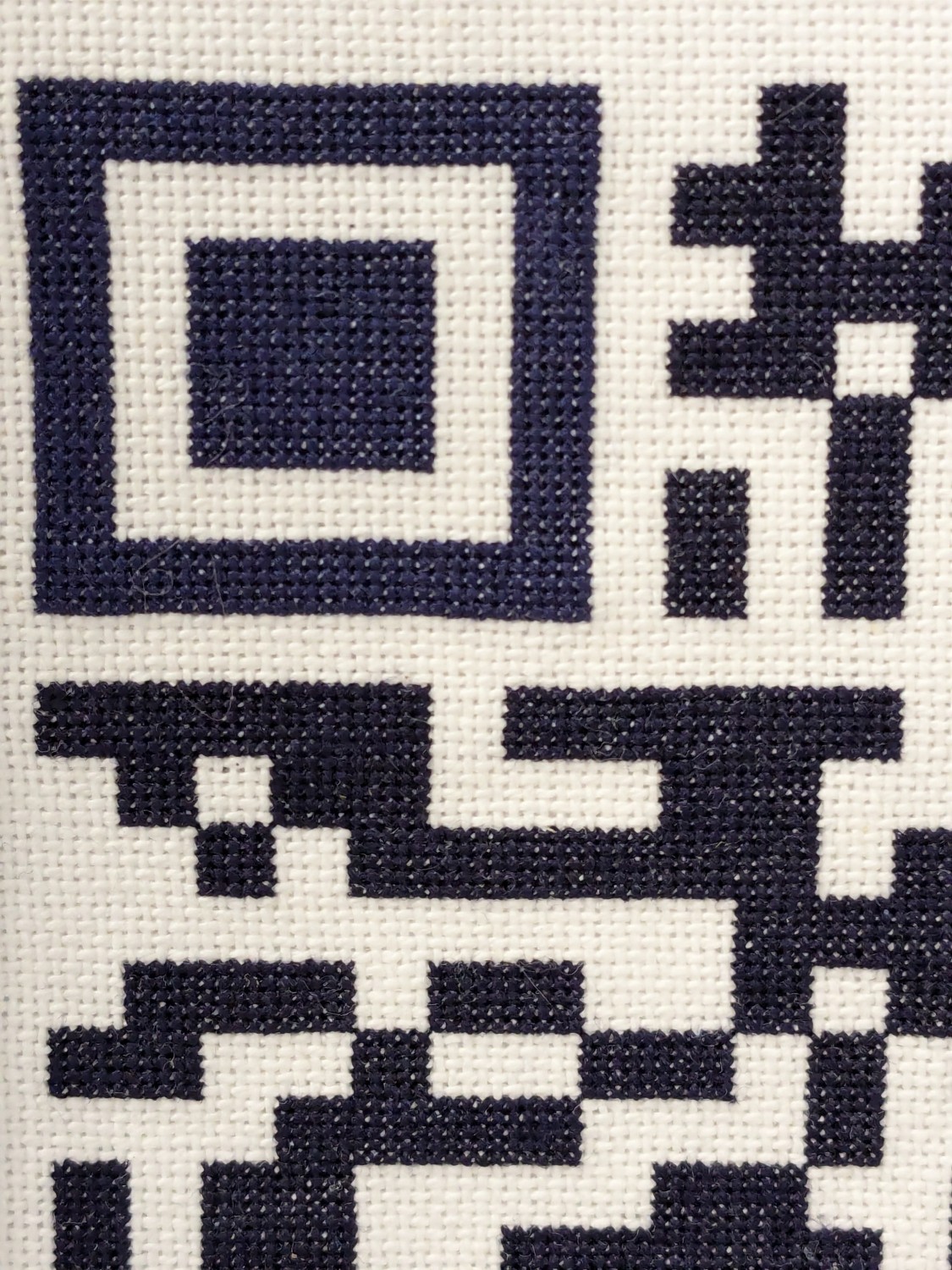
Loose Ends QR Code (close-up)
Yep, that was cross-stitched by a volunteer.
Loose Ends relies on Google Workspace for Nonprofits, a free plan for eligible organizations that offers the full suite including Gmail for business, Meet videoconferencing, Drive storage, Chat, Calendar, Docs, Sheets, and Slides.
"What about Microsoft 365?" I asked.
The answer is that Microsoft offers grants to nonprofits along with preferential pricing on Microsoft 365 Business Standard or Premium, but it's hard to compete with free.
Jen has one of her neighbors, Mark, a professional website architect, building software to keep track of 25,000+ finishers, 2,500+ completed projects, and hundreds of ongoing projects in progress.
In the meantime, they're using Google Sheets to track ongoing projects.
Throughout the duration of a project, finishers are asked to give a status update at least once every two weeks. If someone goes silent for longer than that, a staff member or volunteer will write an email asking for an update.
"Power Automate could easily write those emails for you," I suggested.
Back at my desk on Monday, I developed a proof of concept connecting Power Automate to Gmail and Google Sheets. I had never tried it before and figured it would be a good exercise.
First, I set up a simple spreadsheet:
-
Name
-
Email
-
Last contact (date)
-
# of days since last contact (integer)
-
Reminder email sent (date)
Then, I built a scheduled weekly flow in Power Automate that:
-
Filters the spreadsheet for finishers who've gone two weeks with no contact.
-
Sends an automated email via Gmail to each of those finishers, with mail merge to include name and last contact date.
-
Updates the spreadsheet with the date sent of the most recent reminder email.
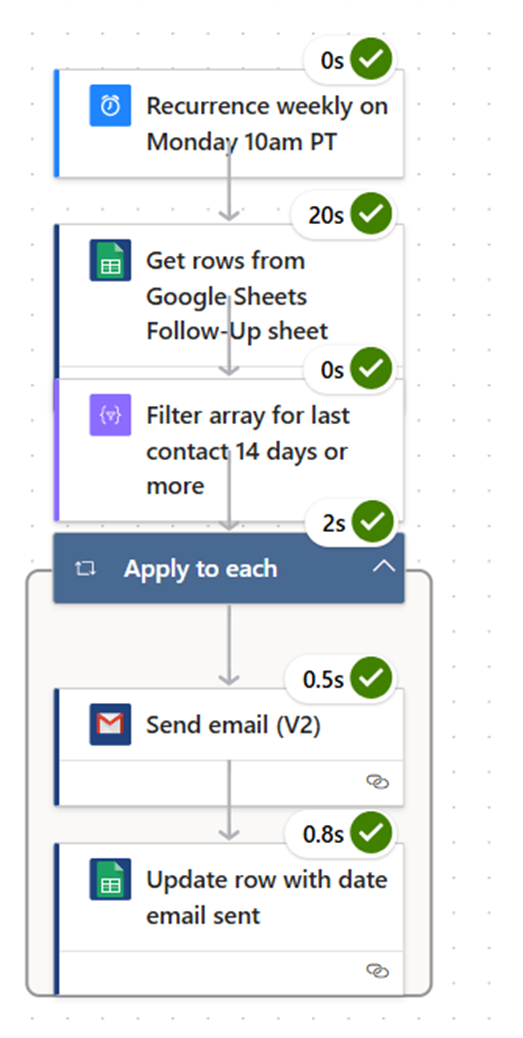
Power Automate flow
But why stop there?
Even with this solution, the staff would still be responsible for updating the "last contact" column by hand.
A second flow could easily monitor emails coming into the mailbox to update the spreadsheet automatically.
Someone would still have to read the emails to make sure it's not a bounce from an inactive mailbox. Also, you'd have to distinguish between the messages "Everything's fine, I'm working on it!" and "Help, I'm in over my head!"
Here's where we could bring in a Copilot for key phrase extraction, sentiment analysis, and orchestration workflow, along with language detection to enable scaling for a global volunteer community.
But why stop there?
A textile database built with Azure AI Vision could automatically analyze images of any unfinished project to detect whether it's knit, crochet, sewing, quilting, tatting, rug-making, embroidery, cross-stitch, Tunisian crochet, mending, amigurumi, needlepoint, basketry, turkey work, felting, nalbinding, applique, spinning, latch hook, punch needling, or weaving.
From there, the best candidate finishers could be identified by analyzing images of their own work, to automate and optimize the matching process.
But why stop there?
By encouraging the finishers to livestream their textile handwork crafting (Stitch Twitch?), the project could amass a large library of video content that could be used to train an AI on how to perform the motions involved in handwork.
And let's build some hardware! Put accelerometers into a pair of knitting needles to gather recordings of precise motions. And how about a pair of motion capture gloves to track and record biomechanical data?
Put it all together, and you'd have enough data to teach GrandmaBot how to make billions of baby blankets.
I'd better stop there.
See what happens when you let the wolves in?
Please share the word about Loose Ends Project. They're already Instagram-famous in the crafting community, but there are untold projects out in the world that still need finishing. By sharing the word, you'll be doing a wonderful thing for families coping with loss.
And for my connections in financial services, it occurs to me that a partnership with Loose Ends is a good fit for financial advisory firms, life insurers, tax advisors, trust companies, and wealth managers. Or better yet, given that projects are matched with local finishers, it's a perfect fit for community banks. What are you waiting for?
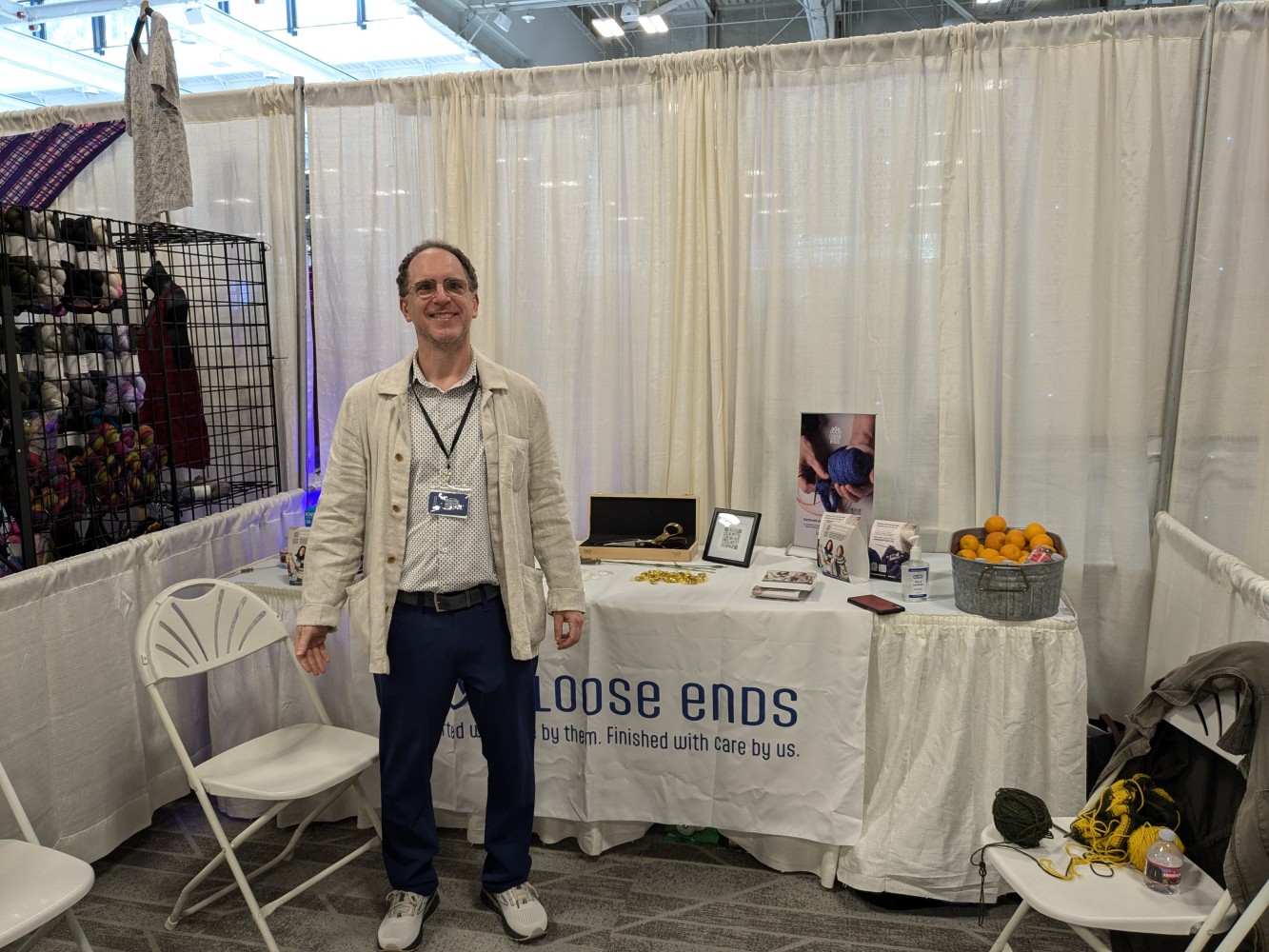
Ivan blending in at Flock