Kill Bull
April 24, 2024
A meditation on mazes and labyrinths
"A maze is a puzzle with hidden turns and dead ends where a wanderer could be lost forever. A labyrinth is a fixed path, designed to carry a person along a controlled journey with a clear beginning and end."
Ellen Lupton, Design is Storytelling (Cooper Hewitt, Smithsonian Design Museum, 2017).
David Malan, teacher of Harvard's ultra-popular Intro to Computer Science CS50 course (available online and off), explains reinforcement learning using the example of a maze.
As shown in the animation below, we start with a grid. Your avatar (the yellow circle) has to make it to its destination (the green square) while avoiding obstacles (red squares). Starting from the corner, there are two possible moves: up or right. Making a random choice, you turn right, directly into an obstacle. You restart, but not before marking off the obstacle with a bright red line. Each successive random walk takes you on another path into an obstacle, or, if you're persistent, to your destination. On that happy occasion, you may mark with bright green lines the successful path from start to finish.
If all you want is a single path from A to B, you can exploit your hard-won knowledge and stop right there.
But if you want the best path from A to B, you must explore the map. That's accomplished by allowing randomness to divert you from the known path.
Suppose you arrive at an intersection. You already know that turning right leads to a deadly obstacle. You also know from experience that the path straight ahead is safe. But with randomness as your guide, you may choose to turn left. Perhaps you'll hit an obstacle or go on a long detour, but maybe you'll find a quicker route to your destination.
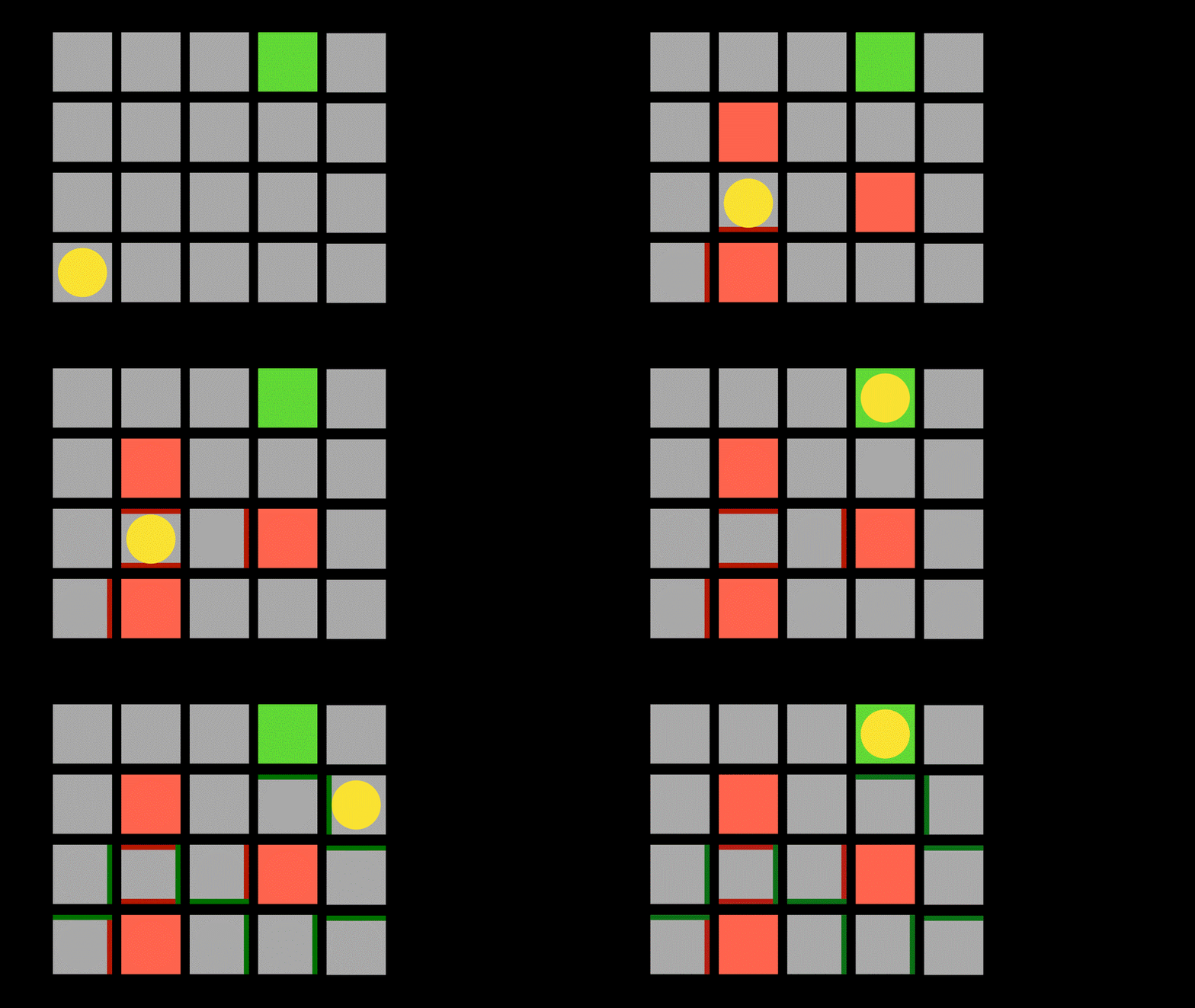
Slides from David Malan presentation: "Using AI as a Personal Tutor" (Seattle, March 25, 2024)
Incidentally, the idea of exploration through randomness was the inspiration for my app concept for Convention City Seattle.
Suppose you're a convention visitor. You arrive at the airport, take a taxi to the hotel, and walk to the Summit for registration and the opening keynote.
If you're stuck in exploit mode, you'll spend the rest of your trip bouncing between the hotel and the convention center without seeing much more of the city.
Far better to introduce randomness that encourages people to explore beyond the obvious, well-trodden paths. And since we wouldn't expect people to undergo a lengthy process of reinforcement learning on their own, we would want to curate journeys on their behalf, showing them the best of Seattle.
That's the idea. It's all in the execution.
Details to follow.
Over the past few months, I've gone through dozens of Microsoft Learn modules, each focused on a different aspect of Microsoft Power Platform. In many of the modules, you are given an exercise with step-by-step instructions for how to accomplish a given task. No matter how complex the instructions, you're told exactly where to click, what to type, and what system responses you should expect. And it's impressively accurate, even over a large and expanding knowledge domain.
Here, we have a labyrinth. The path is long and winding, but if you stick with it, the outcome is never in doubt.
Programming is a maze. You never know when you're going to encounter some kind of unexpected behavior or configuration error or bug. You're not sure if you're solving a problem in the right way, or even if you're solving the right problem.
Does walking the labyrinth help you find a way through the maze? Absolutely. It's essential for knowing what to expect. It just may not prepare you for what you're not expecting.
Poseidon gave King Minos of Crete the gift of a white bull with the expectation that it would be offered back as sacrifice. It was more a loan than a gift. But Minos wanted to keep the white bull, so he sacrificed another in its place.
Poseidon noticed.
Next thing you know, Minos's wife Pasiphaë was also infatuated with the bull. Pasiphaë had Daedalus build her a hollow wooden cow, from which she mated with the bull. They had a mewing, mooing, half-calf baby. Everyone called it the Bull of Minos, or Minotaur.
Soon, the Minotaur gained a taste for people. (Does that make it a cannibull?)
To contain the rage-y Minotaur, the crafty Daedalus built a Labyrinth.
Actually, it was a maze. (Am I maze-splaining?)
It had to be a maze, or else the Minotaur would have easily followed the path to the exit, right through the gift shop.
It had to be a maze, or else some of the young Athenians tossed as sacrificial tribute into the Labyrinth would have quickly escaped.
It had to be a maze, or why else would Ariadne have given Theseus the wise advice to trace his path using a ball of string?
Given enough time, AI turns any maze into a labyrinth.
If AI turns mazes into labyrinths, then there are no more mazes.
If there are no more mazes, the Minotaur cannot be contained.
If the Minotaur cannot be contained, nowhere is safe.
Except, perhaps, inside the maze.
Poseidon gave us the gift of golden beaches.
We turned the sand into silicon microchips and the silicon microchips into computers, and from computers into half-human, half-machine hybrids with artificial intelligence.
I know AI is super adorable now, but just to be on the safe side, maybe it's time to build a Labyrinth?
Paging Dr. Daedalus.