Announcing: Certification Skills Explorer
February 21, 2024
The latest addition to my app portfolio is Certification Skills Explorer, a model-driven Power App with a database of over 4,000 skills measured across 50 Microsoft Certifications.
The prototype app was built over the course of three days using Power Automate, Python (using the Beautiful Soup library), Power Apps, and Copilot.
Day 1: The low-code. I built a Power Automate flow that gets the names of each Certification from the Study Guide pages on Microsoft Learn.
Day 2: The pro-code. Gathering and parsing Skills was way too much for Power Automate or Office Scripts, and so I did the data wrangling in Python.
Day 3: Mix and stir. Imported skills into Dataverse using the data import wizard. Set up some views and calculations. Wrote up my notes today.
Day 4+ No-code. For the next development sprint, there's not much coding involved at all. I'll build out the model with new tables and relationships; views and dashboards; and maybe a business process or two. And every time I press "publish," I'll know that the model-driven app will simply work, ready to expand, ready to scale, and ready to go.

RETURN THE MAP
The territory is not mapped
With Microsoft Learn, it's straightforward enough to study for an exam using documentation and training materials that are comprehensive, free, and impressively well maintained.
You can search by product (e.g. Power BI), role (e.g. Data Analyst), level (Intermediate), and subject (Data management > Data modeling) to find modules and learning paths to meet your precise needs. You can also track your training activities and save collections to your personal profile. Microsoft Learn is a wonderful resource for onboarding and continual learning, perhaps a secret to the company's success. (Hire technical writers! Hire content strategists!)
But there's something missing: the map.
How can we find out where we are, where we're going, and how we'll get there?
The closest thing I found was a certification poster [PDF].
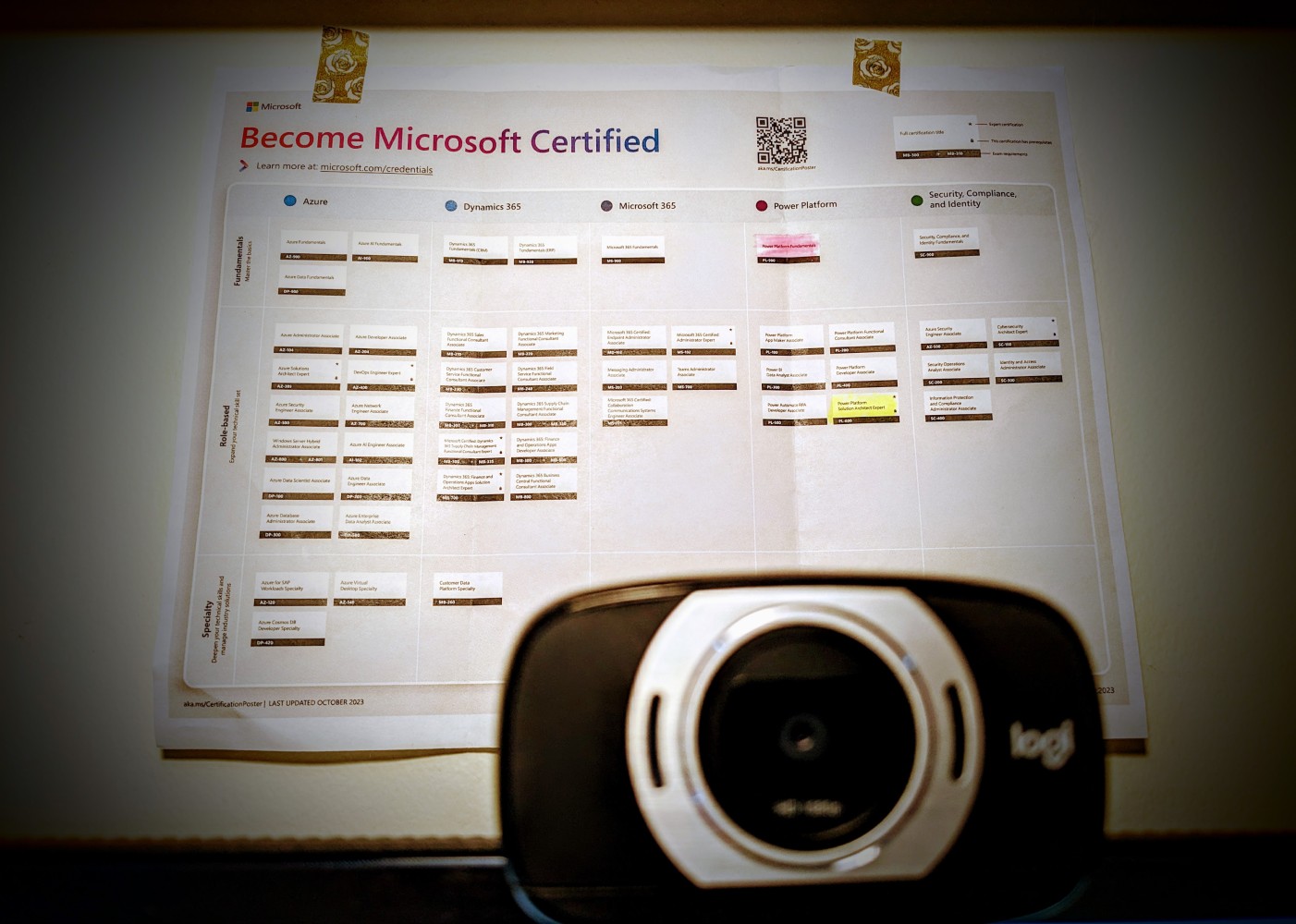
Vision board
The October 2023 edition (still posted on the wall above my desk) has 48 certifications divided into five groups according to product area: Azure, Dynamics 365, Office 365, Power Platform, and Security, Compliance, and Identity.
In the January 2024 edition [PDF], the map has been reshuffled, with 50 certifications divided along functional lines: Infrastructure, Data and AI, Digital app and innovation, Modern work, Business applications, and Security.
I'm very pleased to see that all the Power Platform and Dynamics 365 certifications were brought together under the single banner of Business applications.
Before, I was in one of the smallest categories (16 percent of total). Now, I'm in the largest category (42 percent). That's a good sign about where things are headed and where the jobs are.
Maintaining value of its portfolio of credentials entails a strong commitment by Microsoft: All exams are reviewed annually with a Job Task Analysis (JTA), objectives are revised every two months, and exams are introduced or retired based on the marketplace.
The increasing pace of workplace change leads to an interesting problem.
When you study for an exam, you're hyper-aware of the skill requirements.
And once you've earned your Microsoft Certification, you'll need to recertify annually to keep current.
But how do you keep up with exam changes outside of your narrow specialty?
Certification study guides are forward-looking indicators about Microsoft's expectations on:
-
What job roles are in high demand?
-
What specific tasks are involved with each high-demand role?
Hmm, that seems valuable. We can use those indicators to map out our careers.

"I wonder which way I ought to go." (2023)
What's the next move?
Certifications can inform your choice about what to do next.
Ask yourself:
-
Which skills do I already know?
-
Which new skills would improve my productivity, boost sales, or improve customer service for my company?
-
Which new skills would help me to get a new job or a new client?
-
Which adjacent skills should I learn to open new opportunities?
Using that information, you can make practical, pragmatic choices about what to do next.
For example, suppose you have the MB-800 Dynamics 365 Business Central Functional Consultant Associate certification. You know how to set up and manage the finances, sales, and purchasing operations for SMB clients. Do you:
a) Get under the hood: Learn how to build extensions, develop using the AL programming language, and manage telemetry in Business Central (MB-820, Dynamics 365 Business Central Developer Associate)
b) Chase the AI dragon: Start with the basics in Data and AI (AI-900, Azure AI Fundamentals) and take it from there.
c) Play defense: With SMBs being targeted, you help clients protect themselves by getting specialized training in Security (starting with SC-900, Microsoft Security, Compliance, and Identity Fundamentals).
The right answer: It depends.
-
If I had a big client willing to pay for custom solutions, I'd pick (a).
-
If I was having the AI talk with clients every day, I'd pick (b).
-
If I needed to convince clients to spend money, I'd pick (c).
In any case, I'd want to become broadly familiar with the outlines of each of the three options.
That's where Certification Skill Explorer comes in.
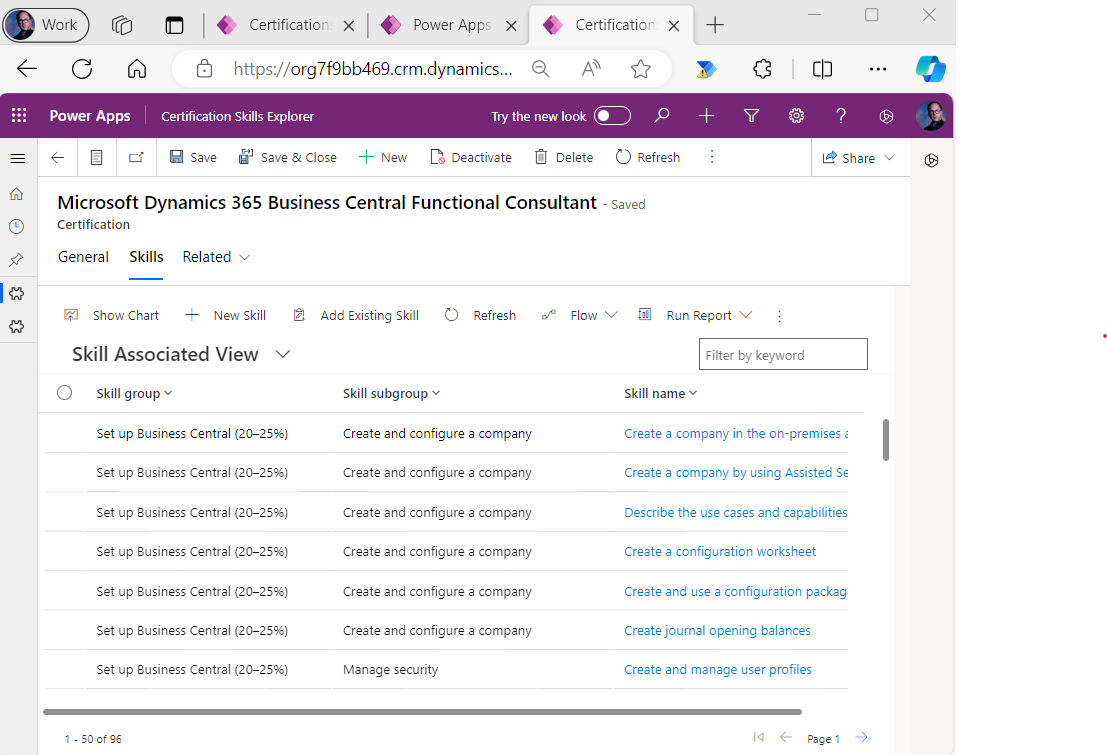
Certificate Skill Explorer: Skills associated with a Certification
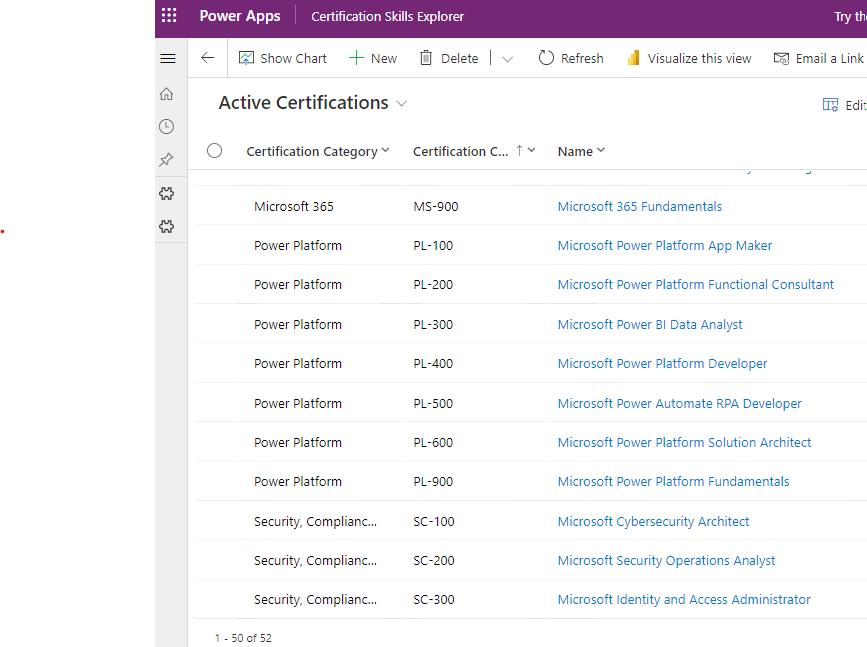
Certificate Skill Explorer: Certifications View
Using a solution based on a collection of learning objectives for each certification, you can:
Keep on track. Monitor progress toward any certifications that you're actively pursuing.
Build a portfolio. Annotate the skill tree with comments and links to completed projects.
Stay sharp. Set up automated reminders to refresh skills that you've already learned.
Look ahead. Identify the best potential future learning paths for your career.
Intelligent news alerts. Set up automated search queries to deliver information personalized for your learning journey.
Learn the territory. Find out what you know -- and what you don't know.

An image that represents the concept "the map is not the territory" in the style of an antique map, with icons that have a steampunk retro technology vibe (generated with Microsoft Designer, 2/21/24)
If you're interested in being a beta tester or in keeping up with my New Adventures in Low-Code, subscribe to my newsletter: Model Citizen Developer.